Walk down any grocery aisle and you'll see "kachi ghani", "cold pressed", "filtered" and "refined" mustard oil side by side at very different prices. They are not the same product, and the difference is easy to taste.
What kachi ghani actually means
Kachi means raw and ghani is the press. Kachi ghani oil is pressed from mustard seed at low temperature, traditionally in a wooden or iron ghani turned slowly. After pressing, the oil is left to settle and is filtered. Nothing is added and nothing is removed chemically.
Because it's never heated hard, the oil keeps its natural pungency. That comes from allyl isothiocyanate, the compound that gives mustard and wasabi their nose-clearing heat. It also keeps its deep golden colour.
How refined mustard oil is made
Refined oil is usually extracted from mustard cake with solvents such as hexane, then neutralised, bleached and deodorised at high temperature. The result is pale and nearly odourless, with a long shelf life, and very little of the character people buy mustard oil for.
Some cheaper "mustard oils" are also blended with other oils. Under Indian rules, a blend has to say so on the label, so read the back of the pack.
How to tell them apart at home
Smell is the quickest test. Kachi ghani oil has a sharp, pungent smell that hits the back of your nose, and you notice it straight away when the bottle opens. Refined or blended oil smells faint or neutral.
Look at the colour too. Kachi ghani oil is a deeper golden-amber, while refined is pale yellow.
Then taste it in the pan. Heat kachi ghani oil until it just smokes and the sharpness mellows into a warm, rounded flavour. That's the traditional way to cook with it. Refined oil doesn't change much because there's little flavour to begin with.
Which should you buy?
If you want mustard oil for its flavour, for achaar, fish curry, sarson ka saag, litti chokha or a North Indian tadka, choose kachi ghani. A refined oil gives you none of the taste you're paying for.
If you want a completely neutral oil for baking or delicate dishes, use a different oil altogether, not a refined mustard oil.
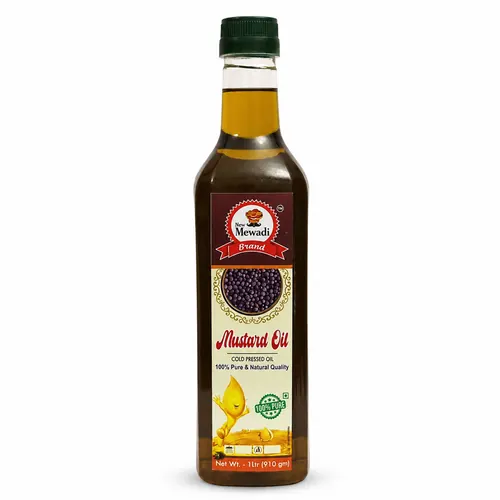
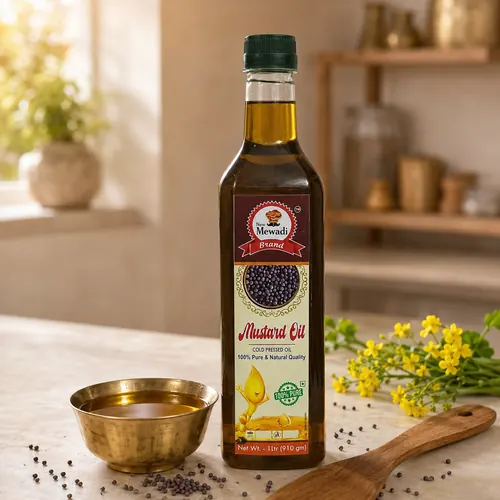
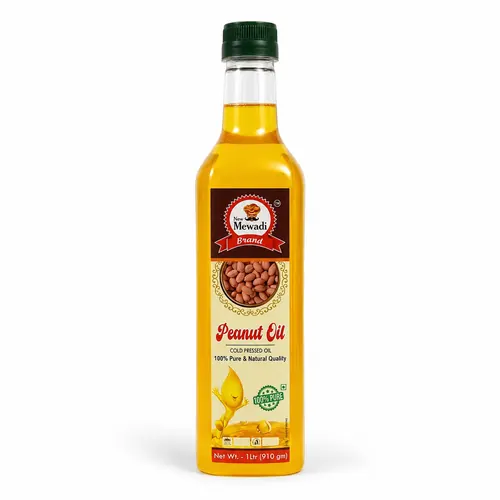
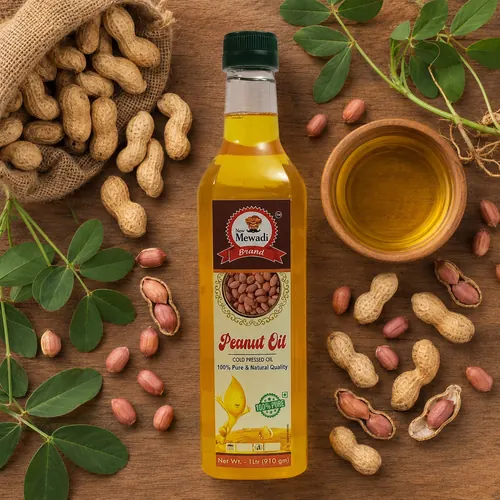
Our kachi ghani mustard oil is 100% mustard seed oil, pressed the traditional way, with no blending. It comes in 500 ml, 1 L and 5 L packs. For deep frying with a milder flavour, see our cold-pressed groundnut oil.
Questions
Why do people heat mustard oil until it smokes?
Heating kachi ghani mustard oil to its smoking point briefly mellows its raw sharpness. Lower the flame right after, then add your spices.
Is kachi ghani the same as cold-pressed?
Essentially yes. Both mean the oil is pressed mechanically at low temperature without chemical extraction or refining.
Why is kachi ghani oil more expensive?
Slow pressing gets less oil out of the same seed than solvent extraction, and the oil isn't stretched by blending.